

What Is The Makeup Of The House Democrats Versus Republicans For 2019
The 117th U.S. Congress took office in Jan, with Democrats holding narrow majorities in the House and Senate.
Apart from its political makeup, the new Congress differs from prior ones in other means, including its demographics. Here are seven charts that show how the demographic profile of Congress has inverse over time, using historical data from CQ Ringlet Call, the Congressional Research Service and other sources.
To decide the demographics of the 117th Congress, we pulled data from recently published Pew Research Centre analyses and other earlier work. Because not all members of the 117th Congress were seated on January. 3, 2021, and because some then-filled seats are now empty or changed hands since that fourth dimension, previously published data comes from several dates. For more than information on the methodology of previously published posts, delight visit the original links, which are in the text of this post.
Information on the educational attainment of members of Congress includes the 532 voting members of the legislature equally of March iii. Data is drawn from the U.South. Congress Biographical Directory and, when relevant, other official biographies and news reports.
All information points reverberate but voting members of Congress, except for the analysis of women in the legislature.
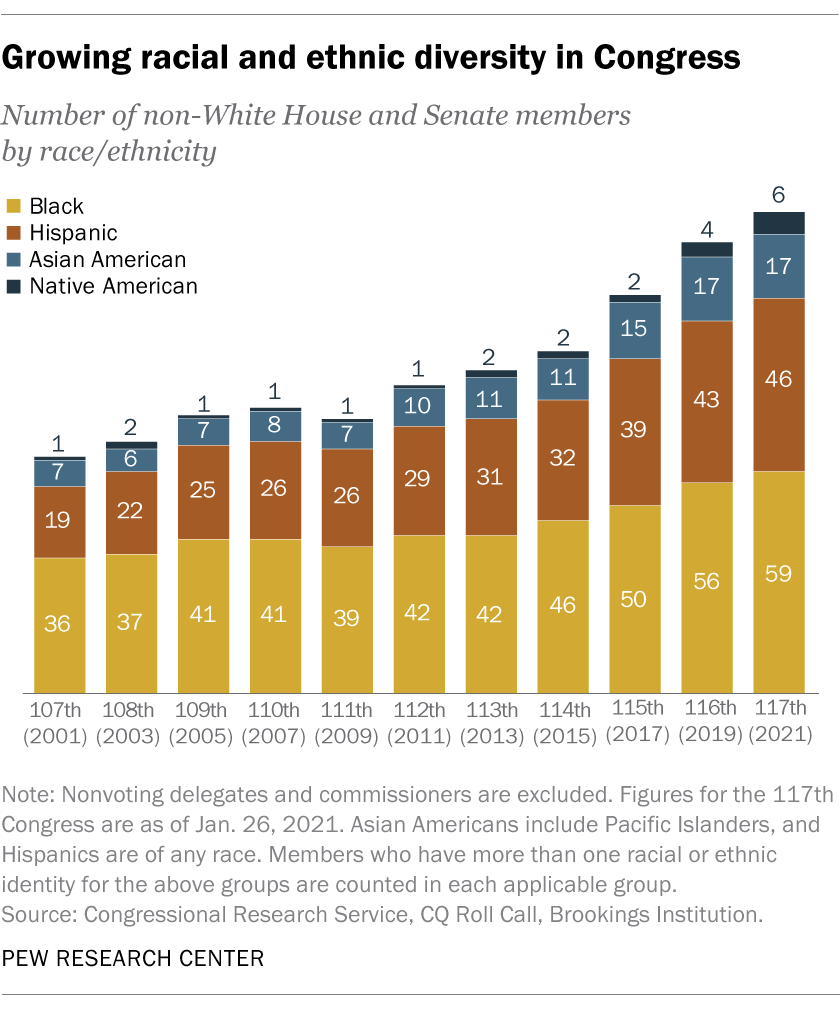
The current Congress is the most racially and ethnically various ever. Overall, 124 lawmakers identify as Black, Hispanic, Asian/Pacific Islander or Native American – making up 23% of Congress, including 26% of the Business firm of Representatives and 11% of the Senate. By comparing, when the 79th Congress took office in 1945, non-White lawmakers represented just ane% of the Business firm and Senate.
Despite this growing racial and indigenous variety, Congress remains less diverse than the nation equally a whole: Not-Hispanic White Americans account for 77% of voting members in the new Congress, considerably more than their 60% share of the U.S. population.
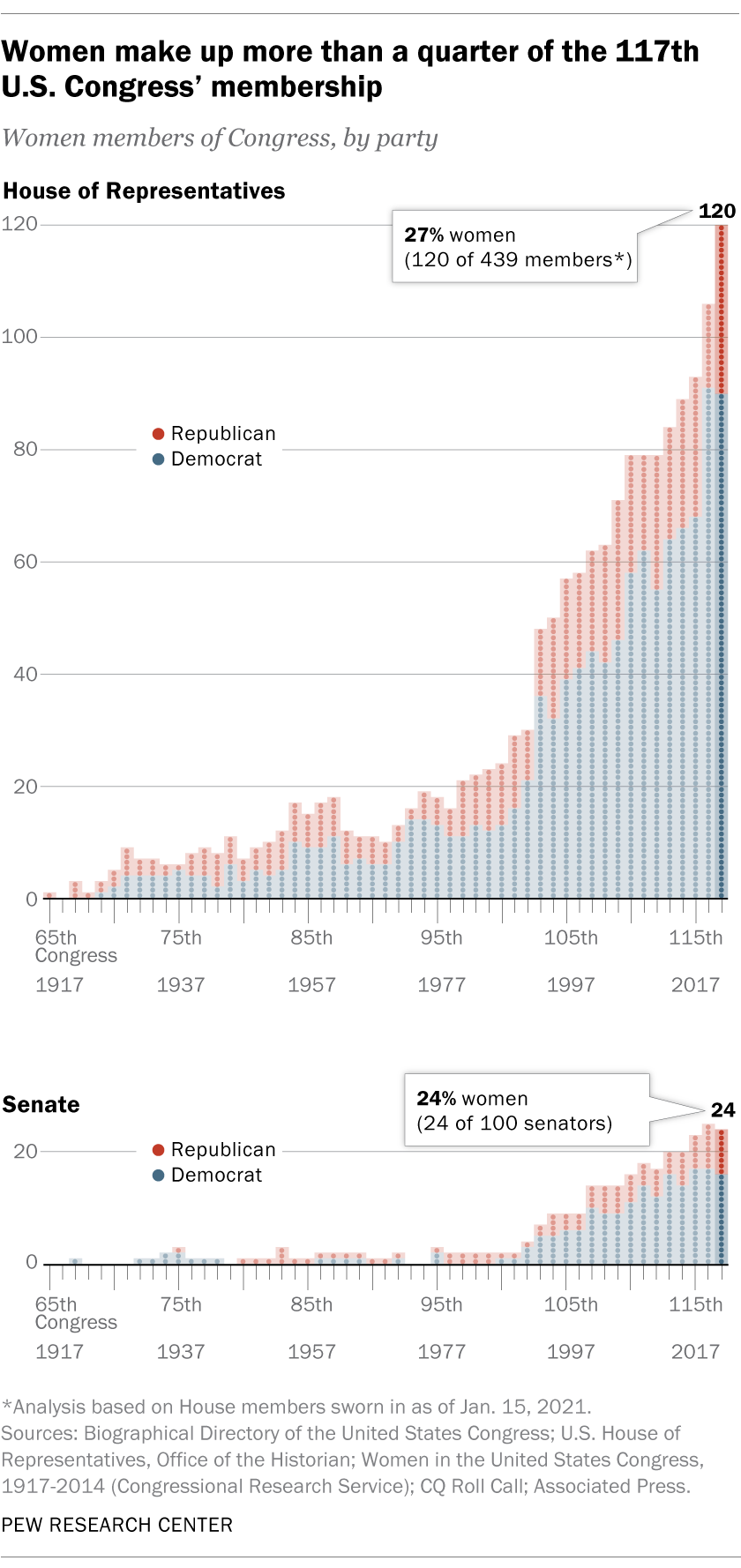
The number of women in Congress is at an all-time loftier.Well-nigh a century after Republican Jeannette Rankin of Montana became the starting time woman elected to Congress, in that location are 144 women in the national legislature, accounting for a record 27% of all members across both chambers. (This includes six nonvoting House members who represent the District of Columbia and U.South. territories, four of whom are women.)
A record 120 women are currently serving in the House, bookkeeping for 27% of the sleeping room's total. There are 24 women in the Senate, i fewer than the record number of seats they held in the last Congress. In four states – Minnesota, Nevada, New Hampshire and Washington – both senators are women, down from six states in the previous Senate.
The House has seen ho-hum but steady growth in the number of women members since the 1920s. Growth in the Senate has been slower: The Senate did not accept more than than three women serving at whatsoever point until the 102nd Congress, which began in 1991. And the share of women in Congress remains far beneath their share in the land equally a whole (27% vs. 51%).
The number of Millennials and Gen Xers in Congress has risen slightly in contempo years. In the current Congress, 7% of House members, or 31 lawmakers, are Millennials (born betwixt 1981 and 1996), upwards from 1% in the 115th Congress. A tertiary of House lawmakers, or 144 members, are Gen Ten (born from 1965 to 1980), upwards from 27% two Congresses earlier.
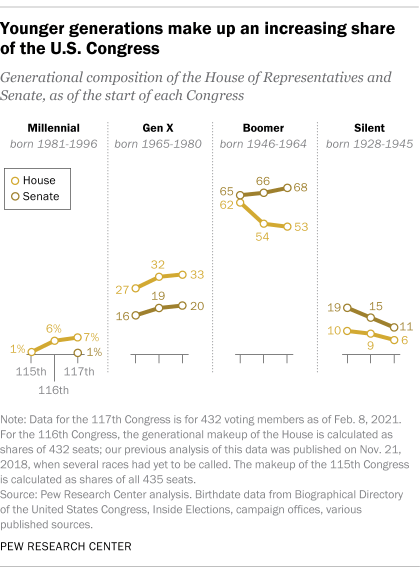
This yr saw the swearing-in of the first Millennial senator: Democrat Jon Ossoff of Georgia. The number of Gen X senators has gradually ticked up from 16 in the 115th Congress to 20 this year.
While younger generations have increased their representation in Congress in contempo years, older generations even so account for the majority of lawmakers across both chambers. Baby Boomers (built-in between 1946 and 1964) make upward 53% of the Firm's voting membership, in addition to 68 of the 100 senators.
The ranks of the Silent Generation (born between 1928 and 1945) have decreased in recent years, from 10%, or 42 members, at the beginning of the 115th Congress to 6%, or 27 members, in the electric current Congress.
The share of immigrants in Congress has ticked upward but remains well below historical highs.In that location are 18 foreign-built-in lawmakers in the 117th Congress, including 17 in the House and just one in the Senate: Mazie Hirono, a Hawaii Democrat who was born in Nippon.
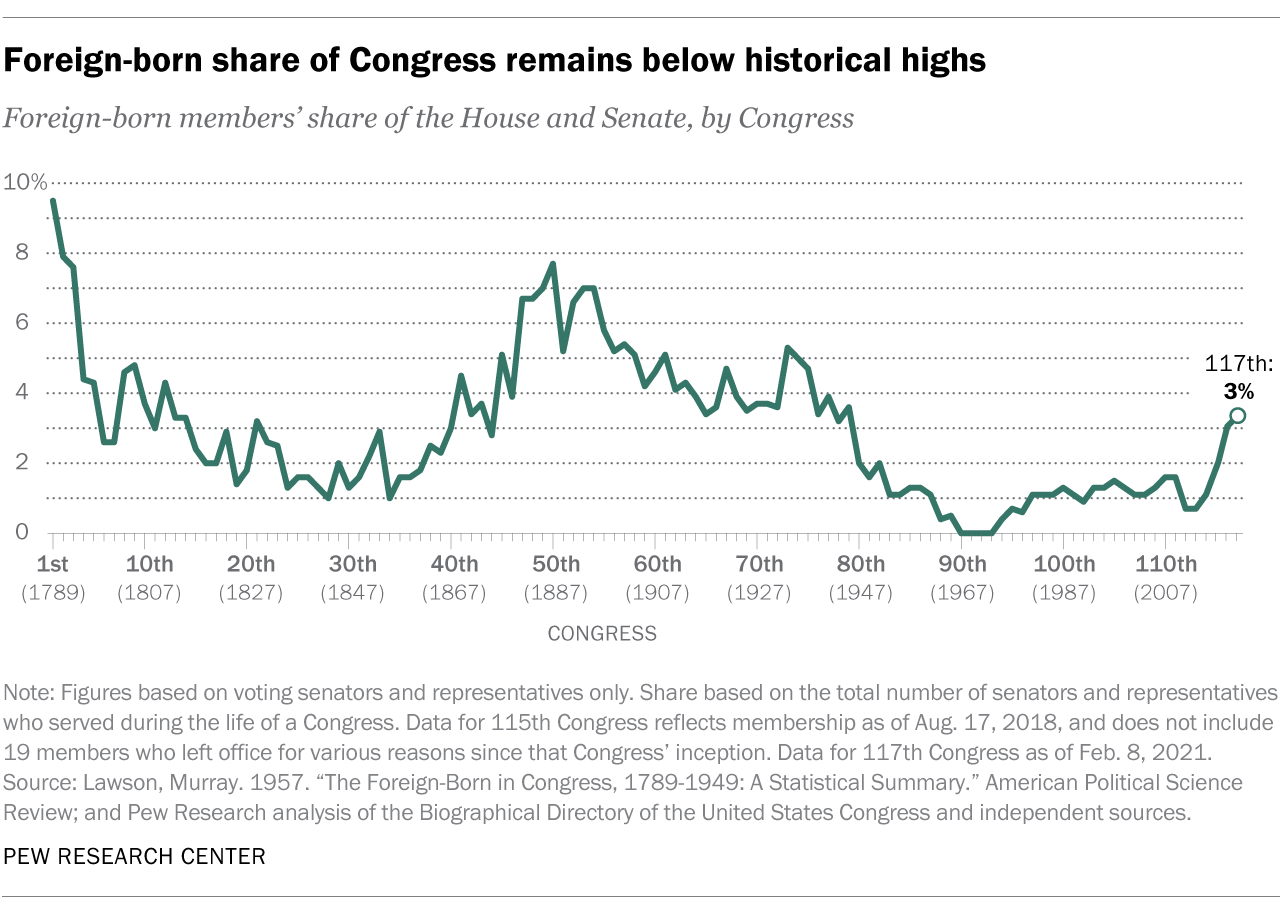
These lawmakers account for 3% of legislators, slightly higher than the share in other recent Congresses just below the shares in much earlier Congresses. In the 50th Congress of 1887-89, for example, viii% of members were born abroad. The electric current share of foreign-born lawmakers in Congress is as well far beneath the foreign-born share of the U.Southward. as a whole, which was xiii.half-dozen% equally of 2019.
While the number of strange-born lawmakers in the electric current Congress is small, more than members accept at least ane parent who was born in another country. Together, immigrants and the children of immigrants account for at least 14% of the new Congress, a slightly higher share than in the last Congress (13%).
Far fewer members of Congress now have direct military experience than in the by. In the current Congress, 91 members served in the military at some betoken in their lives – the lowest number since at to the lowest degree Globe War Ii, according to Armed services Times. There are more than twice as many Republican veterans (63) in the new Congress as Democrats (28). Equal shares of senators and representatives (17%) have served in the military.
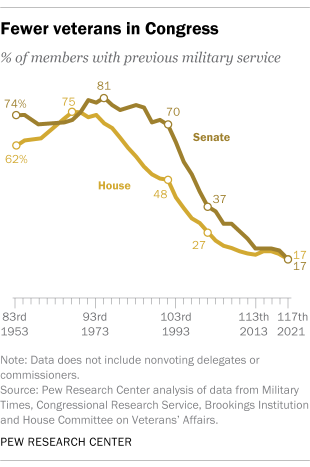
While the number and share of veterans in Congress overall have decreased, the newly elected freshman class includes 15 such lawmakers.
Looking at the longer term, there has been a dramatic decrease in members of Congress with war machine feel since the belatedly 20th century. Betwixt 1965 and 1975, at to the lowest degree 70% of lawmakers in each legislative chamber had military machine experience. The share of members with military feel peaked at 75% in 1967 for the House and at 81% in 1975 for the Senate.
While relatively few members of Congress today have armed forces experience, an even smaller share of Americans do. In 2018, about 7% of U.S. adults had military experience, down from 18% in 1980, not long after the end of the armed services draft era.
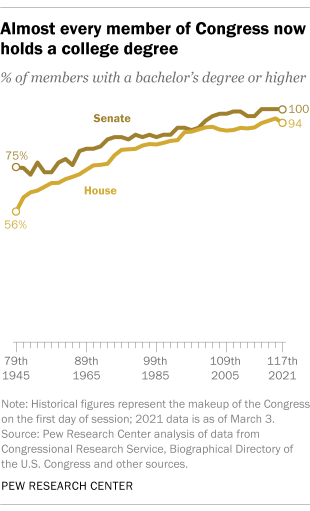
The vast majority of members of Congress have higher degrees. The share of representatives and senators with a college degree has steadily increased over time. In the 117th Congress, 94% of House members and all senators have a bachelor'southward degree or more pedagogy. 2-thirds of representatives and three-quarters of senators have at least one graduate caste, as well. In the 79th Congress (1945-47), by comparison, 56% of House members and 75% of senators had bachelor's degrees.
The educational attainment of Congress far outpaces that of the overall U.South. population. In 2019, around a third (36%) of American adults ages 25 and older said they had completed a bachelor'southward degree or more education, according to U.S. Census Agency data.
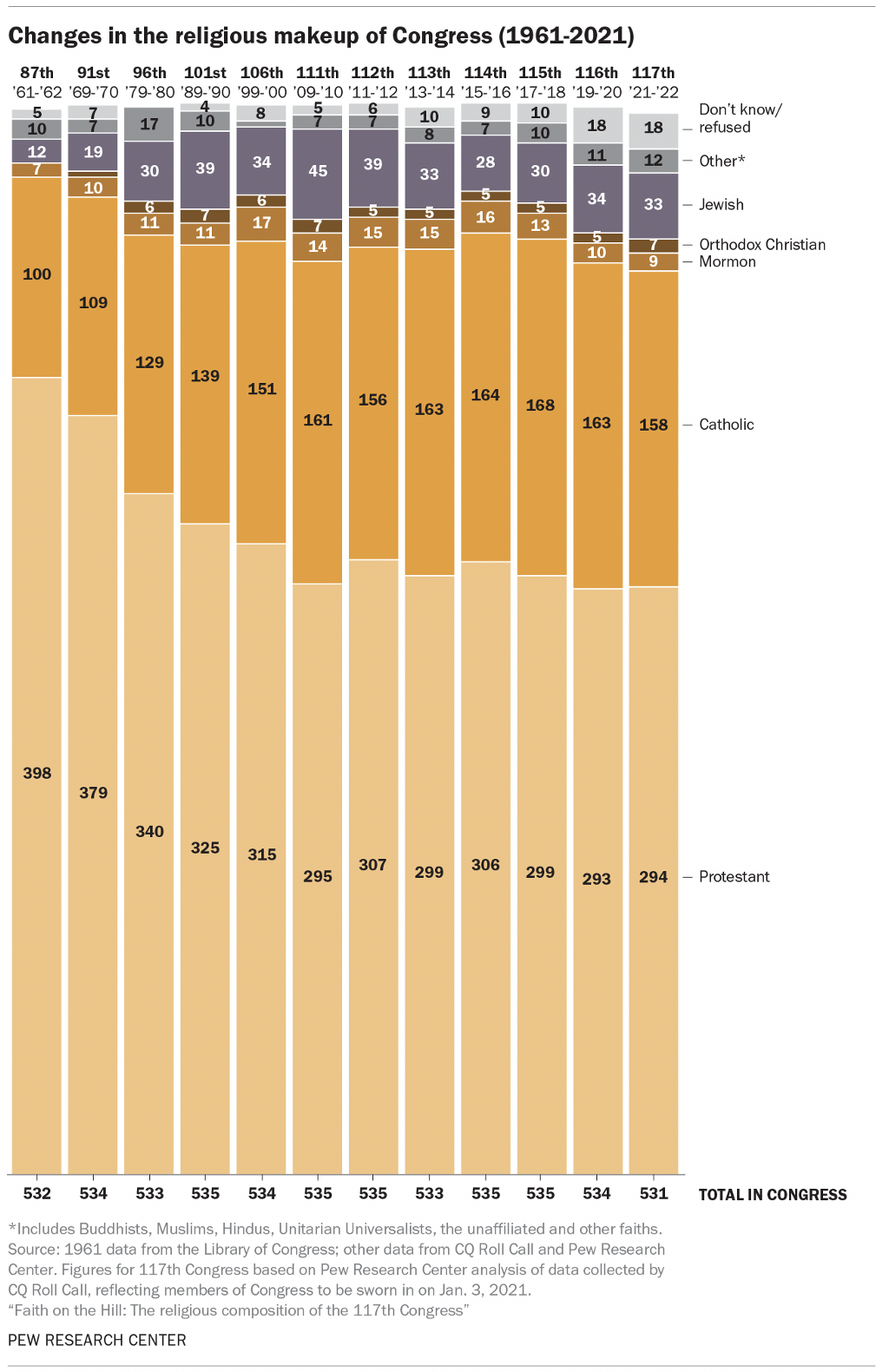
Congress has become slightly more than religiously various over time.The electric current Congress includes the first two Muslim women ever to serve in the House and has the fewest Christians (468) in 12 Congresses analyzed past Pew Research Centre dating back to 1961. Despite this decline, Christians are withal overrepresented in Congress in proportion to their share of the public: About nine-in-x congressional members are Christian (88%), compared with 65% of U.S. adults overall.
By contrast, religious "nones" are underrepresented in Congress in comparison with the U.S. population. While 26% of Americans say they are atheist, doubter or "nothing in item," just i lawmaker – Sen. Kyrsten Sinema, D-Ariz. – says she is religiously unaffiliated.
Note: This is an update to a post originally published on February. 2, 2017.
Source: https://www.pewresearch.org/fact-tank/2021/03/10/the-changing-face-of-congress/
Posted by: autreysenessobling.blogspot.com
0 Response to "What Is The Makeup Of The House Democrats Versus Republicans For 2019"
Post a Comment